Print
Return to Showcase
Visit website

DLF Public School

This content was written by
DLF Public School
Context
DLF Public School, Ghaziabad is located in Delhi NCR. The school serves learners from the primary wing through to Grade 11, fostering academic excellence alongside the development of essential life skills. In pursuit of holistic education, DLF Public School has implemented the Skill Builder Framework, which equips students with eight core skills designed to support success across all aspects of life—both in school and beyond. The school has embraced the Global Accelerator+ programme, unlocking premium resources and global opportunities that make skill-building measurable, structured, and integrated across the entire curriculum.
Overall impact
The implementation of the Skills Builder Framework has created a visible and measurable shift in the culture of teaching and learning across the school. What began as a structured initiative has evolved into a shared language embraced by students, teachers, parents, and the wider school community. One of the most significant impacts has been the development of a consistent skill culture across all age groups, from Grade 1 to Grade 12. Students now demonstrate greater confidence in communication, stronger collaboration during group work, and improved ownership of their learning. Teachers, too, experienced a significant transformation in practice. Through bespoke workshops, targeted training sessions, and the introduction of Non-Negotiables, educators moved from viewing skills as an “additional layer” to recognising them as integral to curriculum delivery. Most importantly, the school witnessed a shift from passive learning to active engagement. Students began asking more thoughtful questions, participating more confidently, collaborating more responsibly, and approaching challenges with greater resilience.
Keep it simple
A strong and visible skill culture was established across the school through clear, accessible strategies: • Our reception area turned into a space of celebration as we showcased our Skills Builder Gold Award—and the response was incredible. With a constant stream of curious passers-by, conversations, congratulations, and admiration, the achievement truly became a shared moment of pride for the entire school community. • Visual skill posters were placed throughout the school premises—classrooms, corridors, staff rooms, and resource areas—creating constant visual recall and a shared vocabulary of skills. • The 8 Core Skills logo was strategically positioned at prominent school locations to reinforce daily awareness. • As part of the post-award celebrations, wall magazine activities were conducted outside each classroom to showcase student learning, reflections, and essential skills in action. • A dedicated section in the student award list was created to recognise essential skills, and impact was shared regularly via the school newsletter with key statistics. • In-school training sessions were conducted by the Principal and Skill Leaders, incorporating interactive activities such as identifying strong evidence of skill use, engaging with non-negotiables, and working with mandatory activities linked to the framework. • Skills Builder organised bespoke, personalised workshops for teachers—facilitated by Ms. Victoria Smith—that were tailored to the specific needs and demands of DLF teachers, with a particular focus on 'Teaching the Step': explicitly embedding each skill step into lesson plans across all subjects and age groups (5 to 18). • A set of Non-Negotiables was created in collaboration with Victoria—a comprehensive guide for teachers outlining essential skill-teaching strategies, assessment practices, and the use of tools like student passports and exit slips. • A Reward Mechanism was launched to celebrate teachers who exemplified optimal skill implementation, evaluated using parameters including Sharing Best Practices, Optimal Hub Usage, Strong Skill-Step and Academic Connect, and Active Participation in Extrapolatory Activities. Gift vouchers were awarded to recognise their commitment. • Targeted parent induction sessions reached over numerous parents in one session, another 440 in a different session, including a dedicated Skill Builder session with hands-on activities and the Skills Builder Silver and Gold Awards were proudly shared with parents across all school wings.
Start early, keep going
This year, the programme was implemented across all year groups from Grade 1 to Grade 12, ensuring age-appropriate skill-building that progressed in complexity as students matured. Ms. Victoria provided differentiated teacher training tailored to each developmental stage, with guidance and non-negotiables for embedding skills appropriately. By starting early—from Grade 1—and sustaining consistent momentum through all school wings, the approach ensured a steady, age-sensitive progression. Essential skills became a visible and consistent part of every learner's journey, with no year group left behind.
Measure it
Assessments were closely aligned with skill objectives, ensuring students not only gained knowledge but also demonstrated skill proficiency. A range of tools and approaches was used to capture evidence of skill development: • Skill Passports and Reflection Sheets were used extensively across grade levels, with prompts such as 'How did I collaborate today?' and 'When did I show creativity in solving a problem?'—making metacognition a daily habit. • Reflection sheets were completed after key projects, classroom activities, and exit tasks, providing insight into student experience and understanding of the skill step. • Listening and Speaking skills were embedded into Periodic Assessments: listening comprehension was assessed through marked worksheets, while speaking was assessed via rubrics during presentations—graded for both content accuracy and demonstration of essential skills. Grade VII Cambridge students summarised passages and restated key ideas in their own words, allowing teachers to assess listening, comprehension, and active recall. • In dramatization activities such as Heroism and Valour, students analysed how misinformation and unreliable heroes affect teams, demonstrating teamwork, speaking, and critical thinking through performance. • Speaking assessments, panel discussions, debates, and presentations are evaluated using targeted rubrics focused on clarity, responsiveness, collaboration, and confidence. These activities provide direct evidence of growth in leadership, communication, teamwork, and adaptability, while also enabling teachers to track skill progression across age groups and learning contexts.
Focus tightly
The eight core essential skills were embedded across all subjects and year groups, spread evenly over the academic session. Key strategies included: • A comprehensive Programme of Study (POS)—a whole-term planning document shared with teachers, students, management, and parents—outlined both academic topics and the specific skills to be developed in each unit. • Detailed Planning in the form of —curriculum document for each subject. This outlines activities in detail tailored to the specific lessons in the subject curriculum. • Challenge Days were integrated into the programme, where students combined and applied their skills in innovative ways, including an Entrepreneurial Challenge. Printed group assessment sheets for focus skills were included. • Differentiation was central: for younger learners (Grades 1–5), skill integration was playful, visual, and experiential, with teachers modelling skill steps through collaborative games and storytelling. By senior school (Grades 9–12), skill use became more independent and self-directed, linked to subject-specific tasks, debates, real-world applications, and leadership opportunities. • A student-led orientation for parents was organised, where learners demonstrated how skills are used in class, reinforcing the language of skills and showcasing differentiated learning in action.
Keep practising
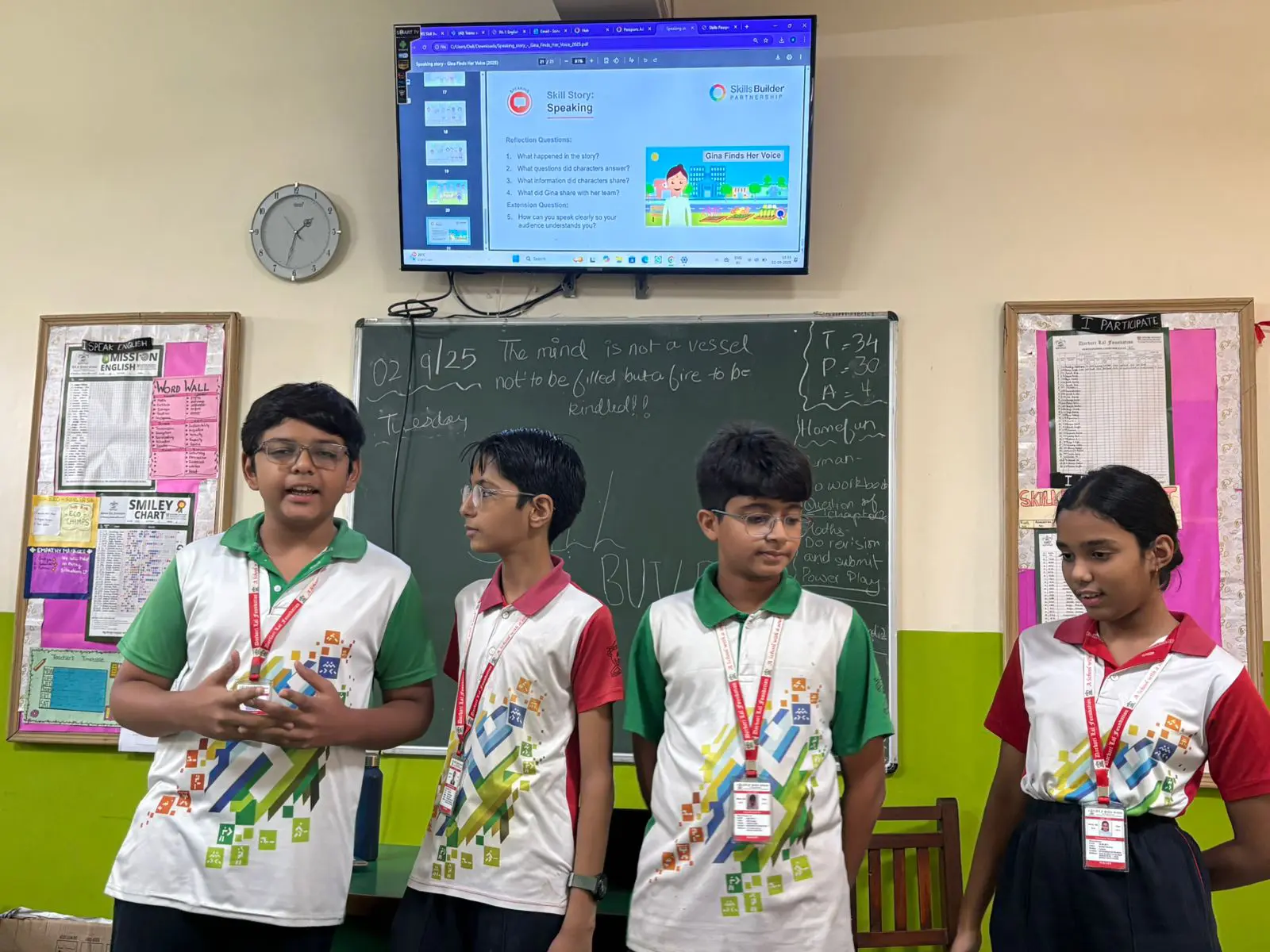
Essential skills were explicitly embedded in subject lesson plans, with teachers referencing specific skill steps when designing learning objectives and activities. Examples of subject integration included: • Problem-Solving integrated into Maths investigations • Speaking and Listening woven into English debates and assessments • Teamwork embedded in Science experiments • Creativity applied in Art and Social Science projects Skill reinforcement happens continuously through varied subject activities and repeated application. Grade IV students engaged in folklore dramatization, where they learned responsibility, teamwork, and creative expression through music, drama, and narration. Grade VI students debated whether zoos should continue to exist, practicing speaking, planning, and adaptability through structured argumentation. In Grade V, students designed kites carrying social messages after analysing visual aids, integrating speaking and creativity into an engaging real-world activity. Grammar Pentathlon activities in Grade IV transformed language learning into collaborative problem-solving exercises, building teamwork and planning in an energetic format. Reflection-based speaking activities in Grade VIII encouraged students to respond spontaneously to prompts and practice voice modulation, audience engagement, and clarity of expression. Through such repeated exposure across subjects and formats, essential skills become embedded habits rather than isolated lessons. Students were given consistent opportunities across all subjects to use and reflect on essential skills through group tasks, peer feedback, and project-based learning. Bespoke workshops run by subject teachers and Skill Leaders helped students see how skills transfer beyond academics into everyday life. A supportive community culture was fostered through a WhatsApp group for educators to share their work and celebrate small wins, alongside a Social Media Campaign that brought skill-based learning into the public sphere. Short video shoots featuring teachers speaking about classroom activities and outcomes were posted across social media channels.
Bring it to life
The school brought skills to life through a range of impactful, real-world experiences: • Grade VIII, students explored universal adult franchises through a comparative study of elections in India and the USA, strengthening problem-solving, adapting, and leadership through research and discussion. Grade IV learners created and used handmade compasses to understand direction-finding, making problem-solving tangible through hands-on investigation. • Creativity was brought alive in Grade IX through comic-strip biographies on Indian leaders, where students transformed historical learning into visual storytelling. In another interdisciplinary task, Grade VI students designed Indus Valley seals inspired by ancient civilisation studies, combining speaking, creativity, and presentation skills. • Global issues were also integrated meaningfully. Grade VII students collaboratively created news reports on extreme weather conditions, strengthening teamwork, speaking • Global Skill Exchange with Healing Primary Academy, England: Students from Grades 4 to 11 engaged in a cultural and skill-sharing session via Zoom, sharing reflections on skill-building and cultural insights. One student offered a vivid depiction of Kashmiri culture, which sparked admiration and thoughtful discussion from English peers—a live demonstration of communication, empathy, curiosity, and adaptability. • Entrepreneurial Challenge and Social Media Campaign for Classes VI–XII: Students created, marketed, and sold products—managing customer queues, pricing, billing, and negotiations—developing real-time problem-solving, financial literacy, persuasive communication, and resilience.
What's next
DLF Public School is committed to deepening and expanding its Skills Builder journey. Having built strong foundations this year—from whole-school skill integration and award-winning educator training to a Global Skill Exchange and an Entrepreneurial Challenge—DLF Public School, Ghaziabad is now focused on going deeper, wider, and more visible with its Skills Builder work. • Scaling the Global Skill Exchange: building on the success of the partnership with Healing Primary Academy, England, the school plans to extend its global collaboration network—connecting more grade groups with international peers and creating regular, structured opportunities for cross-cultural skill application in communication, empathy, and adaptability. • Ms. Gargi’s Zamit Capacity Building research on group work and student outcomes will be shared more formally across departments. The school intends to encourage more educators to undertake similar practitioner research, making evidence-based skill teaching a defining feature of professional development at DLF PS. • Expanding the Entrepreneurial Challenge: following the strong response from Classes VI–XII, the school will develop further real-world application events where students manage end-to-end projects—from ideation to execution—strengthening problem-solving, financial literacy, and leadership in authentic, high-stakes contexts. • Energising the educator community: the WhatsApp community for teachers will be further activated as a peer-learning space for sharing classroom clips, skill reflections, and best practices. The Reward Mechanism will be refreshed each term to spotlight new skill champions and sustain the culture of recognition that has been so central to DLF PS’s success. • Amplifying student voice: the school’s social media presence will continue to grow, with students taking greater ownership of how skill stories are told—through reels, blogs, and campaign content that celebrate learning in action. This will also deepen the home–school connection, keeping parents active and informed partners in the skills journey.
India