Established in 2012 and licensed by the Vietnamese Government, Greenfield School is a leading bilingual private school in Hanoi. As a member of the Cambridge International School System, we serve nearly 3,500 students and 350 staff across MOET, Cambridge, and Global Citizen (GC) pathways. Our mission is to develop responsible, adaptive citizens,which prompted our journey with the Skills Builder framework in 2022-2023.
Building on our foundational work, the framework is now a core pillar of our Personal Development Skills (PDS) subject. This academic year, we strategically customized our syllabus. Recognizing that "Listening" and "Speaking" are rigorously taught and practiced within our English and Vietnamese Literature programs, we removed them from standalone PDS classes. This allows PDS to focus deeply on the remaining six essential skills. Concurrently, we are comprehensively embedding all eight skills across core subjects like Math, Literature, English, and Community Services. As we apply for the Accelerator this year, we are ready to deepen this customized, cross-curricular integration.
The overall impact has been a transformative embedding of the essential skills framework within our school, driven by highly intentional curriculum design. Fully engaging with the Accelerator, our dedicated lead team utilized Skills Builder training to equip our faculty with pedagogical tools to shift from theory to practice. This enabled teachers to actively use the Skills Builder Hub and create a unified, skills-focused culture.
The most significant impact is the creation of a precise, shared language of skills that transcends individual subjects. By focusing PDS classes on six core skills and seamlessly transferring Listening and Speaking to language arts, students clearly understand how different competencies connect. We see students confidently self-assessing their Teamwork strengths during Community Service projects or articulating Problem Solving strategies inMath. The programme has provided a structured roadmap, ensuring our students develop into the well-rounded, responsible citizens that define the Greenfield experience.

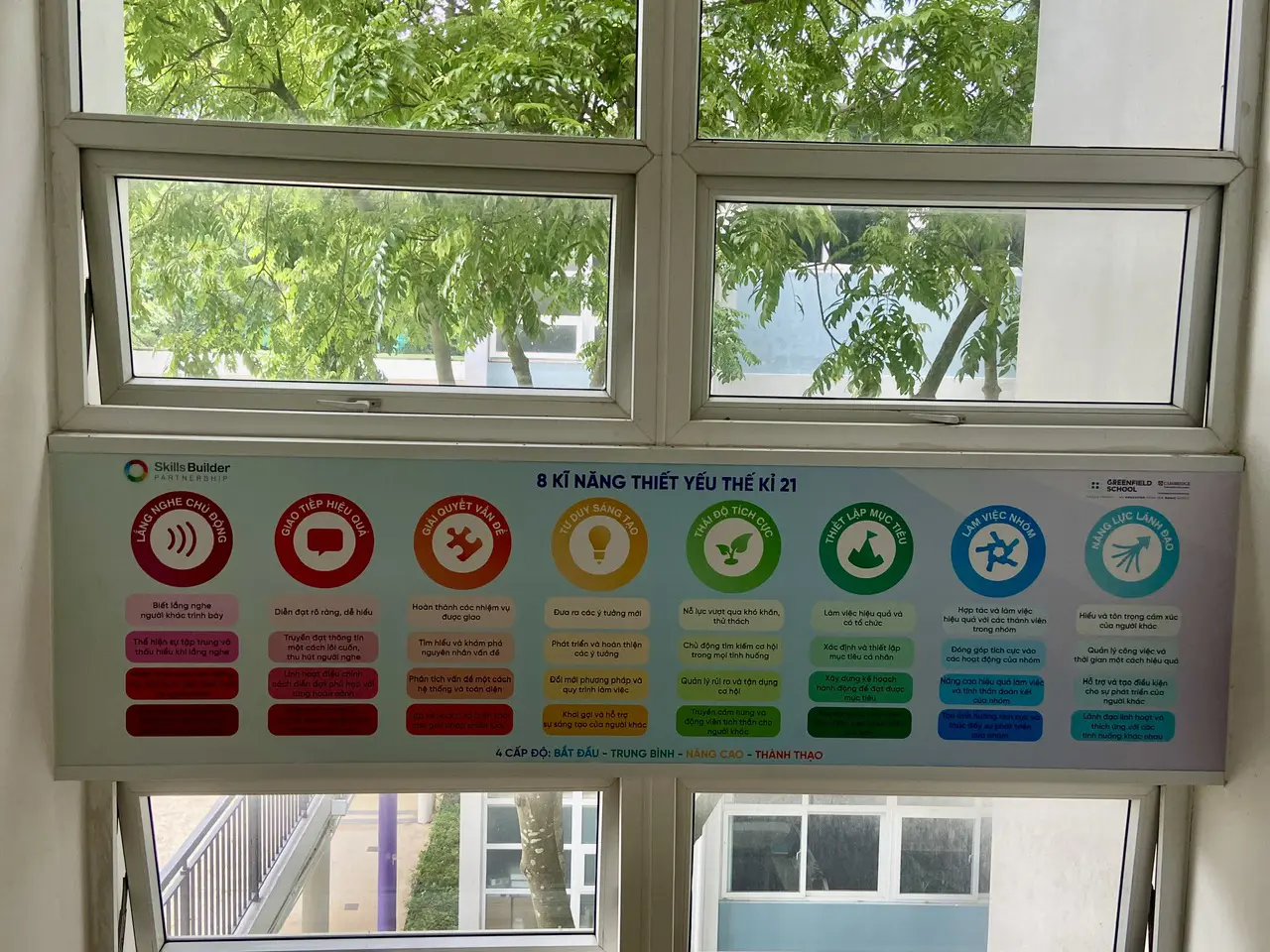
We embedded "Keep it Simple" by making the framework a ubiquitous and consistent part of our curriculum. Within PDS and core subjects (Math, Literature, English, Community Services), the skills and their icons are seamlessly integrated:
Daily Classroom Language: Teachers explicitly reference skill steps in lesson objectives, establishing a shared terminology across departments.
Targeted Feedback: Formative and summative feedback frequently refers to specific skills and steps, making it highly actionable for students.
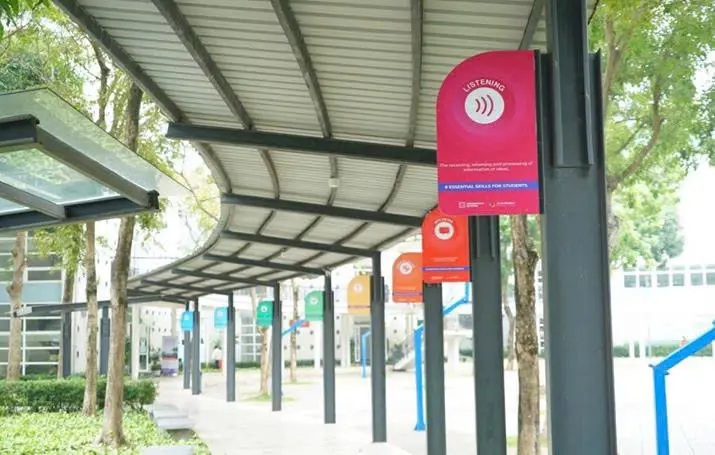
Parent Communications: The skills are a key discussion point in parent-teacher conferences and report cards, making parents active partners in the process. While we use school-wide visual displays and workshops to build general awareness, the deep, consistent use of this simple language is intentionally structured within our specific syllabi to ensure maximum effectiveness without overwhelming students.

Our approach utilizes a strategic, phased rollout to create a continuous K-12 skills journey.
Phase 1 (2022-23): We launched a focused pilot in our High School GC pathway to establish best practices.
Phase 2 (2023-Present): Following its success, we formally expanded the programme into our Middle & High School. Current State: We now utilize a customized, vertically aligned curriculum map for Grades 6-11. For instance, a Grade 7 'Teamwork' activity in PDS focuses on sharing ideas equitably, while a Grade 11 Community Service project demands advanced conflict management.
Furthermore, as Listening and Speaking scale in complexity through Literature and English progression, the remaining six skills scale simultaneously within PDS and Math. We are also mapping foundational skill-building into our Primary curriculum so younger students arrive in Middle School with a solid base to "Keep Going".

We focus tightly by empowering our teachers to break down broad competencies into single, teachable steps. A lesson is precisely targeted at a specific step, rather than a general skill.
Differentiation in Practice: Our customized syllabus enables deep focus. Because Listening and Speaking are heavily targeted in Literature and English, those teachers can differentiate specifically on articulation and audience awareness. Meanwhile, in a PDS class focused on 'Adapting', students who have mastered a step are challenged with an extension task, while struggling students receive direct instruction and scaffolding.
Assessment Support: Assessments on the Skills Builder Hub are fundamental to this tight focus. Teachers assess their students, identify the exact step to target for the majority of the class, and plan differentiation up and down the framework, ensuring every student works at their specific point of need.

We ensure continuous practice by intentionally mapping skill development across the entire curriculum, establishing a powerful synergy between our dedicated PDS classes and core academic subjects.
While PDS provides explicit instruction on six core skills, English and Vietnamese Literature classes serve as the primary practice grounds for Listening and Speaking, utilizing Socratic seminars and debates to hone these competencies.
In Math, students consistently practice Problem Solving and Critical Thinking through complex, real-world equations and collaborative group challenges.
Most notably, our Community Services program acts as the ultimate synthesis lab.Here, students must practice all eight skills—using Planning to organize a charity drive, Leadership to guide their peers, and Speaking to pitch their initiatives. This cross-curricular reinforcement ensures students recognize these skills as fundamental tools required for holistic success.
We bring skills to life by connecting classroom learning to authentic, real-world challenges that directly benefit our wider school and local community.
Community Services Projects: Our students lead campus-wide and local initiatives, such as waste reduction programs. They use Problem Solving to analyze the issue,Teamwork to implement solutions, and Speaking (honed in language arts) to report findings to school leadership, creating real-world impact.
Industry Engagement: We host guest speakers who share how they utilize the eight essential skills in their careers. Students then participate in focused Q&A sessions to explore the global application of these competencies.
Authentic Problem-Solving: Programs like our Global Citizenship Scholarship challenge applicants to develop detailed initiatives addressing community issues, pushing them to apply Creativity, Leadership, and Planning to solve tangible problems.
Having successfully established the Beginning Level with a highly effective, customized syllabus, our clear goal is to deepen this integration and advance to the Intermediate Level.
Advance Skill Levels: We aim to successfully embed the Intermediate Level across Grades 6-11, moving beyond foundational teaching to challenge students with complex, multi-step projects that require a sophisticated synthesis of skills.
Deepen Teacher Expertise: We will provide advanced training for faculty across all departments—especially PDS, Math, Literature, English, and Community Services. We will establish a Professional Learning Community (PLC) to share best practices for cross-curricular, Intermediate-level instruction.
Enhance Student Agency: We are introducing formal digital portfolios. Students will curate evidence of their skill development across all subjects—linking a Speaking presentation from English with a Leadership reflection from Community Services—using these portfolios in student-led conferences to demonstrate holistic mastery.