This content was written by
Základní škola, Česká Lípa, 28. října 2733
School motto "A school where everyone finds their place." Our school is a place where we view education not merely as the transmission of knowledge, but as preparing children for life. We believe that just as important as mathematics, Czech language, or natural sciences are the abilities to cooperate, listen, communicate, take responsibility, and handle new situations. That is precisely why we have integrated the development of soft skills into everyday school life. The school is attended by approximately 800 pupils, and their education is cared for by nearly 80 pedagogical staff members. Our team also includes teaching assistants, a special educational needs teacher, a speech therapist, an ethopedist, and other specialists who together create an environment where every pupil can find their place and develop their potential.
The Skills Builder Accelerator program brought us more than just a new methodology. It helped us create a shared language, thanks to which teachers and pupils today better understand what it means to develop skills needed for life. We realized that we were already carrying out many of these activities before. However, Skills Builder enabled us to connect these activities, plan them systematically, and reflect on them consciously. The development of soft skills did not become a standalone project, but a natural part of teaching, homeroom sessions, student council work, after-school care, and extracurricular activities. Today, it is not just teachers talking about skills; pupils talk about them too. They can name what they are learning, where they are improving, what their strengths are, and what they want to work on next. We consider this change to be one of the greatest benefits of the program. We have also incorporated the Skills Builder methodology into the school curriculum. The development of soft skills has thus become part of the school's long-term strategy and shared pedagogical vision.

From the beginning, we knew that we did not want to create an additional project. Our goal was to learn to recognize soft skills in everyday school situations, consciously name them, support them, and reflect on them together. It turned out that simplicity is indeed the greatest strength of the whole program. Skills are not separate from instruction – they are a natural part of it. Teachers plan them, pupils develop them, and together they track their progress.

For us, the development of soft skills begins as early as the preparatory classes and continues across the entire school. Pupils from both primary and lower secondary levels, as well as the after-school care program, are involved.
Starting from the 2025/2026 school year, we also introduced Personal and Social Education as a standalone subject from Year 4, creating regular time and space for targeted skill development. Pupils repeatedly return to individual skills across various subjects, projects, and school events. Thanks to this, they realize their own progress and gradually take responsibility for their learning.

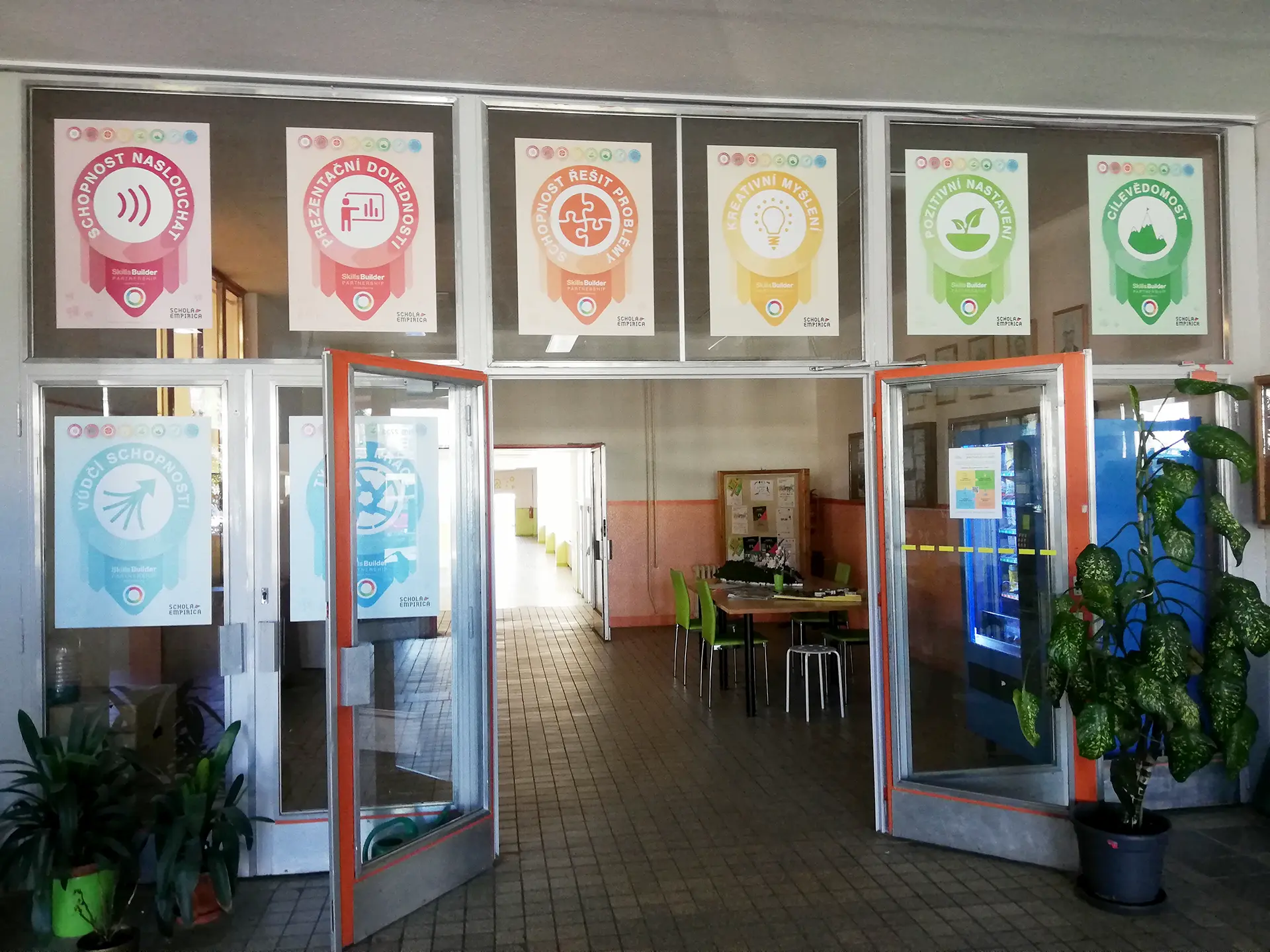
We place great emphasis on reflection. Pupils regularly reflect on which skill they were developing, what went well, and what they want to work on next. Educators use self-assessment, peer feedback, verbal evaluations, and visually structured steps for individual skills. In some classes, we also work with skill stickers that pupils stick into their workbooks when practicing a skill. Each teacher chooses tools that correspond to the pupils' age and the nature of the instruction. However, the shared goal remains guiding children to realize their own progress and build the ability to plan their further development.

In the beginning, we chose a shared, school-wide focus. In the first term, we developed listening skills, and in the second term, presentation skills. However, practice showed us that we achieve the best results when teachers have the flexibility to adapt skill development to their specific subjects and the current needs of their pupils. As a result, working with skills became a natural part of daily instruction.

Learning through real experiences is the most effective. Pupils develop their skills during student council work, Earth Day, project days, classroom activities, and school events. They learn to cooperate, communicate, plan, organize, and resolve unplanned situations. In this way, skills do not remain theoretical, but become an everyday experience.
Our goal is for pupils to be able to apply the skills they have acquired outside of school. That is why they participate in organizing the "Škrpál" hiking trip, the Garden Party, the Christmas market, and the Open Day. They regularly collaborate with a local Alzheimer's care center, where they foster empathy, communication, and intergenerational understanding. A particularly meaningful experience was participating in the Velvet Festival, where pupils prepared the program themselves, acting as hosts and organizers of the entire event. In situations like these, they verify for themselves that the skills gained at school hold genuine value in real life.
We view soft skills development as a long-term journey. Starting in the 2026/2027 school year, we plan to hold regular monthly teacher meetings focused on one specific skill at a time. Together, we will share best practices, plan activities, inspire one another, and reflect on teaching experiences. Our goal is to further develop formative assessment, encourage student self-assessment, and strengthen teachers' ability to consciously plan for soft skill growth. We want every pupil, from their first day at school until the end of Year 9, to progressively acquire skills that will help them succeed not only in school, but also in personal life. For us, this is the true fulfillment of our motto – "A school where everyone finds their place."