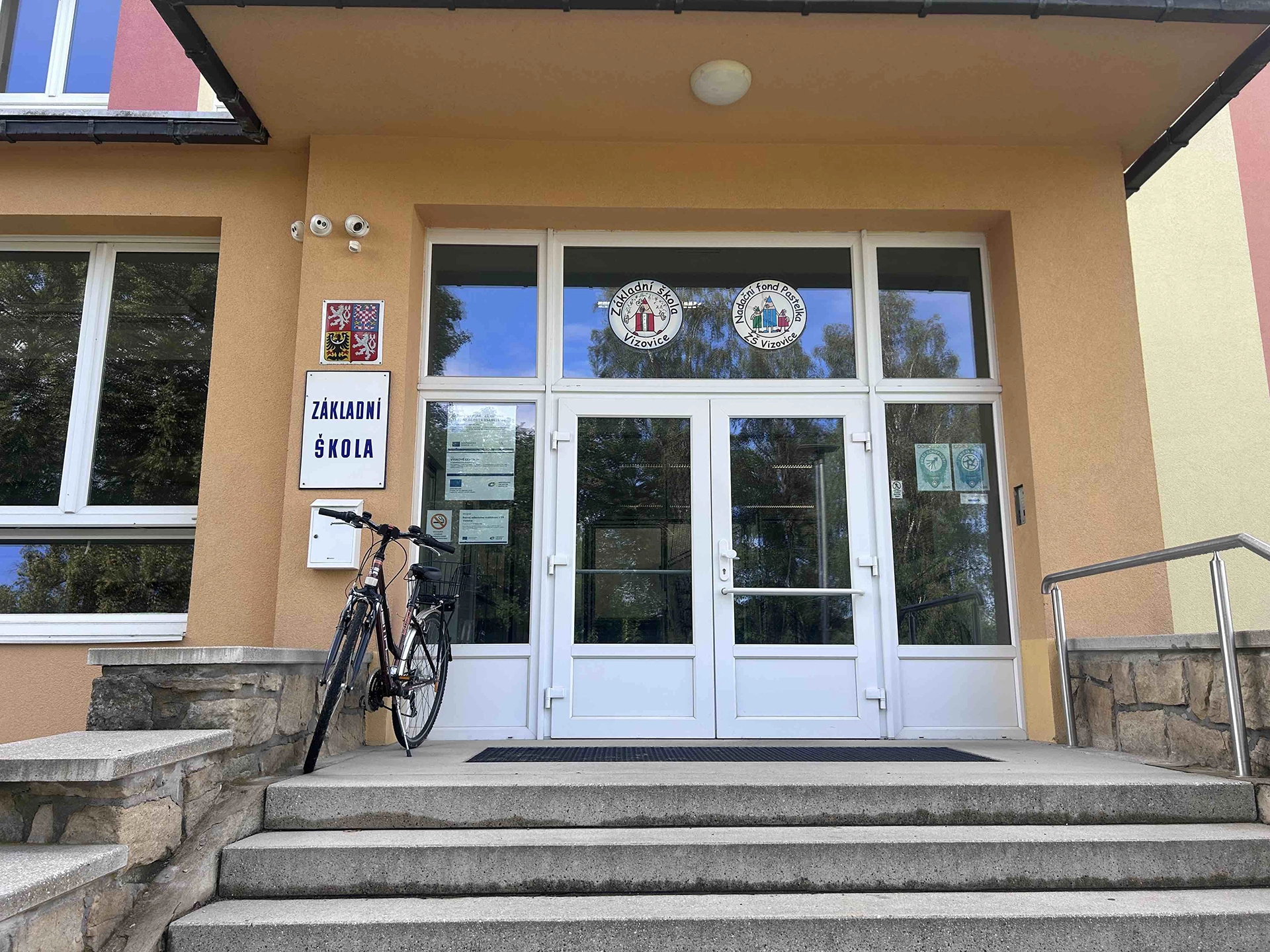
ZŠ Vizovice educates approximately 640 pupils. The primary level is attended mainly by children from Vizovice, while the lower secondary level is also attended by students commuting from nearby villages. Our teaching staff consists of 57 teachers and 15 teaching assistants who work together to provide high-quality education.
The School Counselling Centre is an essential part of our school. It includes a prevention specialist, a school psychologist, an educational and career counsellor, a special education teacher, and a social pedagogue. In addition, seven after-school educators provide care for pupils in Years 1–3.
Our school is divided into two buildings: the historic building, dating back to 1892 and located on Masaryk Square, and the newer building on Školní Street. This arrangement perfectly reflects our educational philosophy. Our staff embraces modern teaching approaches while maintaining deep respect for history, local folklore, and traditions.
Pupils in Years 1–9 follow the school curriculum "Path to Knowledge 2." Our educational programme focuses on developing key competencies alongside academic knowledge through modern teaching approaches, including the RWCT methodology and the Skills Builder framework.
We strive to make purposeful use of digital technologies and to provide strong support for foreign language learning. This includes an optional English Conversation course, a native English-speaking teacher on our staff, an English-language section in the school library, educational trips to England, and regular participation in English language competitions, where our pupils consistently achieve excellent results.
Whole-school projects form an important part of school life. These include the annual school ball (this year's theme was Jožin z bažin), the Patrons programme, in which Year 9 pupils mentor first graders, the Vrbové exchange programme, annual whole-school project days (this year featuring David Attenborough for Years 4–9 and the 100th anniversary of Hurvínek for Years 1–3), visits by local kindergarten children, a sports day organised by Year 3 pupils for preschool children, and our annual Open Day.
Each year, pupils can choose from a wide range of elective subjects, including Robotics, Computer Graphics, Chemistry Laboratory, Biology Laboratory, English Conversation, Czech Language Practice, Mathematics Practice, and Sports Games. Optional extracurricular subjects include Athletics, Religious Education, and the Cimbalom Folk Ensemble.
In recent years, we have placed particular emphasis on developing reading literacy. To support this goal, we established a Reading Club that encourages a lifelong love of reading, develops pupils' ability to work with texts, and strengthens the skills needed for successful secondary school entrance examinations. We also work closely with the Vizovice Public Library and the Local Action Group for the Vizovice and Slušovice regions.
For more than 50 years, ZŠ Vizovice has maintained a partnership with the primary school in Vrbové, Slovakia. Over the years, these exchanges have developed into an annual sporting event where pupils from both schools compete in athletics, kin-ball (girls), and football (boys).
At our school, we place great emphasis on mutual respect and creating a safe and supportive environment. We encourage our pupils to take responsibility for their relationships and their surroundings. We believe that a sense of safety and belonging is the foundation of successful learning. For this reason, school climate is one of our highest priorities.
This commitment led us to adopt the Skills Builder programme, which we believed would provide a systematic framework for developing pupils' essential skills while also strengthening our positive school culture. We are delighted to say that it has fully met our expectations.
We joined the Skills Builder programme at the end of August 2025. During the teacher preparation week, our entire teaching staff—70 members, including primary and lower secondary teachers, teaching assistants, and after-school educators—took part in an introductory training session.
Following the training, our three Skills Builder leads (representing the primary level, lower secondary level, and the deputy headteacher) identified and invited colleagues to become more closely involved in the programme. Every teacher who was invited accepted the opportunity. As a result, nine class teachers now systematically and intentionally develop their pupils' essential skills using the Skills Builder framework. Every year group at the primary level is represented, while at the lower secondary level the programme is currently focused mainly on Year 7 classes. During the first weeks of September, two additional primary teachers joined the team on their own initiative.
As we discussed essential skills and the Skills Builder methodology, we realised that these competencies had always been a natural part of our teaching. However, our approach had often been intuitive rather than fully structured and systematic. The Skills Builder framework provided us with a shared language and a coherent structure that aligned our efforts to develop pupils' essential skills.
Thanks to Skills Builder, our teaching now has a clearer structure, stronger direction, a more consistent approach, and well-defined learning objectives.

When planning lessons that explicitly focused on essential skills, we built on our existing teaching practice and the methods and activities that had already proved effective. In other words, we did not introduce anything fundamentally new. Instead, this school year our priority was to establish a shared language, make each skill clearly visible and understandable, and consciously discuss these skills with our pupils.
The Skills Builder Coordinator created an MS Teams group consisting of 11 teachers and the school leadership team. This online space is used to discuss ideas, share teaching resources, and exchange practical classroom activities. It also contains all the materials provided by Schola Empirica, including visual resources, parent letters, assessment sheets, and the Map the Terrain and Track Progress tools.
At the beginning of each month, the coordinator sends a message to all staff via our school communication platform, introducing the skill of the month, providing methodological guidance, and sharing links to relevant classroom activities.
The Skills Builder programme has been discussed regularly during staff meetings and at parent meetings in the pilot classes. At the beginning of each month, parents of pupils in the pilot classes receive a message explaining the skill their children are focusing on, together with practical suggestions for reinforcing it at home. The wider community has also been informed through articles published on the school's website and in the local newspaper.

In September, we carefully planned how the Skills Builder programme would be implemented across the school. From October until the end of the school year, we consistently followed this agreed structure.
Essential skills are developed systematically across the entire primary phase through class teachers, with one pilot class in each year group. At the lower secondary level, the programme is currently embedded throughout Year 7 in History, Czech Language and Literature, and English lessons. Pupils in other year groups also encounter the Skills Builder framework during school events, projects, and through visual displays around the school.

In the primary phase, essential skills are discussed most frequently during the first and last lesson of the week. We also revisit them whenever pupils gather for our regular class circle sessions, which take place at least once a week and often more frequently. Essential skills are highlighted during group work, collaborative learning activities, and both long-term and whole-school projects.
At the primary level, the systematic development of essential skills is integrated across a wide range of subjects and learning areas.
At the lower secondary level, a structured programme is in place throughout Year 7 in History, Czech Language and Literature, and English. Each month focuses on one specific skill, followed by self-assessment, individual teacher feedback, and portfolio reflection.

Each month, parents receive a letter explaining the essential skill that pupils are developing, together with practical ideas for supporting that skill in everyday family life.
Beyond engaging parents, we also make essential skills visible through many of the projects and events organised by our school. These include:
our annual School Ball, which requires close collaboration between staff, pupils, and parents while promoting teamwork, leadership, problem-solving, and creativity;
our whole-school Project Day for Years 4–9, which this year focused on the life and work of Sir David Attenborough;
our Project Day for Years 1–3, celebrating the 100th anniversary of the Czech puppet character Hurvínek;
our long-standing partnership with our sister school in Vrbové, Slovakia;
the Patrons programme, in which Year 9 pupils mentor and support first graders throughout the school year;
our close partnership with the Vizovice Kindergarten, whose children regularly visit our school, while Year 3 pupils organise and lead an annual sports day for them.
These authentic experiences allow pupils to apply their essential skills in meaningful real-life situations beyond the classroom.
We intend to continue building on the system we have established. We have found it to be clear, well organised, and highly effective for our school community. As our teachers gain more experience with the Skills Builder framework, we will continue refining our practice and further embedding the systematic development of essential skills across the whole school.