See contents



In the UK, the Essential Skills Tracker series has found strong links between higher levels of essential skills and positive outcomes for individuals; those with higher levels of essential skills tend to have increased wages, are more likely to use, and be confident with, new technologies such as AI, and have increased life and job satisfaction.
This paper analyses the latest adult skills data (PIAAC Cycle 2) from the OECD. It features a novel construct for measuring problem solving called Adaptive Problem Solving (APS).
Governments, institutions and organisations across the globe are increasingly adopting the Skills Builder Partnership’s rigorous approach to essential skills, with partners in more than 50 countries. The publication of the new PIAAC and its inclusion of APS is therefore timely.
Using Large Language Models for semantic analysis, the problem solving constructs of APS are shown to align with skill steps of the Universal Framework. This dataset therefore enables exploration of whether the findings of previous Essential Skills Trackers hold on an international scale.
The OECD's PIAAC Cycle 2 (2023) represents a conceptual evolution in the measurement of adult competencies (OECD, 2021).1 The first cycle of PIAAC (2012) assessed "Problem Solving in Technology-Rich Environments" (PS-TRE), which focused on assessing individuals’ ability to use “digital technology, communication tools and networks to evaluate information, communicate with others and perform practical tasks”.2
This paper replicates and expands upon the seminal work of Hanushek et al. (2015), which used PIAAC Cycle 1 data to demonstrate robust wage returns to cognitive skills across the globe.3
APS has three features:
1. ibid
2. PIAAC Expert Group on Problem Solving in Technology-Rich Environments (2009). PIAAC Problem Solving in Technology-Rich Environments: A Conceptual Framework. OECD Education Working Papers, No. 36. Paris: OECD Publishing.
3. Hanushek, E. A., Schwerdt, G., Wiederhold, S., & Woessmann, L. (2015). Returns to skills around the world: Evidence from PIAAC. European Economic Review 73, pp. 103-130
4. OECD (2024), Do Adults Have the Skills They Need to Thrive in a Changing World?: Survey of Adult Skills 2023, OECD Skills Studies, OECD Publishing, Paris
A central challenge in human capital policy is bridging the gap between high-level measurement and practical intervention. While PIAAC provides a robust, cross-national measure of Adaptive Problem Solving,5 it does not, by design, offer a pedagogical framework for developing it.
This is the role of the Skills Builder Universal Framework. It provides the necessary translation mechanism, demonstrating how the construct measured by PIAAC can be systematically taught and acquired. The APS construct, defined by its focus on "dynamic situations" and "metacognitive processes"6 7, aligns directly with steps of the Framework’s Problem Solving skill.
| APS descriptor | Framework match 1 | Framework match 2 | Framework match 3 |
|---|---|---|---|
| Integrate multiple sources of information and their interactions, identify and disregard irrelevant information, and formulate relevant cues. | Listening Step 16 - Evaluating perspectives: I objectively evaluate and integrate different perspectives | Problem Solving Step 10 - Recognising patterns: I identify patterns to gain insight | Problem Solving Step 11 - Systems thinking: I identify how parts of a system impact each other |
| Identify and apply multi-step solutions towards one or more complex goals | Planning Step 7 - Thinking ahead: I think about routes to achieve a goal | Problem Solving Step 14 - Strategic planning: I develop strategic plans to address complex problems | Problem Solving Step 5 - Creating options: I create different possible solutions to a problem |
| Search for solutions by setting sub-goals and evaluating alternative solutions to the problem | Planning Step 7 - Thinking ahead: I think about routes to achieve a goa | Problem Solving Step 5 - Creating options: I create different possible solutions to a problem | Problem Solving Step 7 - Evaluating options: I choose between possible solutions based on success criteria |
5. OECD (2021). The Assessment Frameworks for Cycle 2 of the Programme for the International Assessment of Adult Competencies. OECD Skills Studies. Paris: OECD Publishing
6. OECD (2021). The Assessment Frameworks for Cycle 2 of the Programme for the International Assessment of Adult Competencies. OECD Skills Studies. Paris: OECD Publishing
7. OECD (2024). Survey of Adult Skills – Reader’s Companion. OECD Skills Studies. Paris: OECD Publishing

8. Hanushek, E. A., Schwerdt, G., Wiederhold, S., & Woessmann, L. (2015). Returns to skills around the world: Evidence from PIAAC. European Economic Review 73
9. Jacob A. Mincer (1974), "The Human Capital Earnings Function," in Schooling, Experience, and Earnings (NBER), pp 83–96
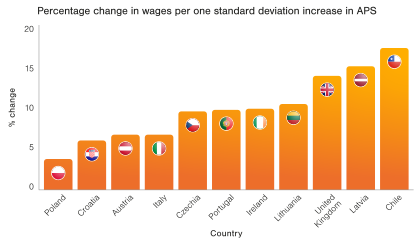
| Country Name | Age group where APS has the most impact on earnings |
|---|---|
| Lithuania | entry-age (18-34) |
| Poland | entry-age (18-34) |
| Austria | prime-age (35-54) |
| Chile | prime-age (35-54) |
| Czechia | prime-age (35-54) |
| Ireland | prime-age (35-54) |
| Italy | prime-age (35-54) |
| Latvia | prime-age (35-54) |
| Portugal | prime-age (35-54) |
| United Kingdom | prime-age (35-54) |
| Croatia | exit-age (55+) |
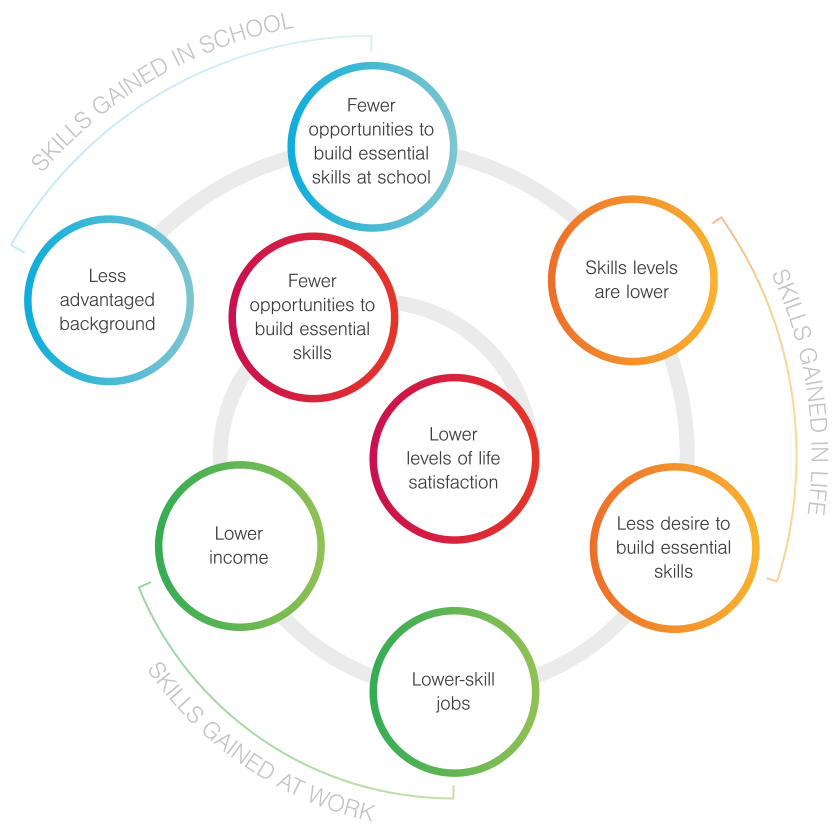
Previous instalments in the Essential Skills Tracker series found the existence of a persistent “Skills Trap”, where individuals from less advantaged backgrounds face a cycle of restricted opportunities leading to worse outcomes.
The introduction of Adaptive Problem Solving as a replacement for Problem Solving In Technology Rich Environments, and the links between higher levels of this skill and income are reflective of a global shift towards more human-centered skills.
Previous Essential Skills Tracker installments found links between Essential Skills, such as Problem Solving, and an increase in wages, wellbeing and reduction in unemployability within the UK10. PIAAC Cycle 2 data provides a platform to explore whether these correlations persist globally through the lens of Adaptive Problem Solving (APS). Although this construct is different from problem solving as defined by the widely adopted Universal Framework, mapping using Language models highlights the overlap between the Universal Framework and APS.
While the PIAAC data shows a clear relationship between Adaptive Problem Solving and economic and social outcomes, the data reveals the limitations of this single assessment construct. In particular, there is high multi-colinearity between literacy, numeracy and Adaptive Problem Solving in Cycle 2 of PIAAC. While each independently predicts other outcomes, when adding the other terms to regression models, there is little or even negative improvement to their predictive value.
The correlation scores between the three skills sits at approximately 0.88. During Cycle 1, the correlation between PR-TRE and literacy and numeracy was lower at 0.79 and 0.73, respectively11. While this shows a strong relationship between these competencies, it is important to note that this level of correlation is consistent with the relationship between literacy and numeracy themselves (0.89). Literacy and numeracy measure different aspects, and given that the correlations are consistent, it therefore does not suggest that APS is assessing the same constructs as literacy and numeracy, nor does it indicate that APS is merely a proxy for general intelligence.
The high correlation between the constructs does, however, suggest that there is a need for differentiated measures of essential skills. The Universal Framework provides this granularity by breaking this into eight essential skills, each with 16 steps. The APS was designed as an objective assessment, in contrast, the purpose of the Universal Framework is as a teaching, learning or workforce planning tool. We therefore do not seek to draw any direct comparisons between the two constructs. Instead, this paper analyses some of the differences and their implications.
10. Seymour, W. and Craig, R. (2023). Essential Skills Tracker 2023. London: Skills Builder Partnership
11. Hanushek, E. A., Schwerdt, G., Wiederhold, S., & Woessmann, L. (2015). Returns to skills around the world: Evidence from PIAAC. European Economic Review 73