Japan: Reframing AI to support young people’s economic futures

In the global narrative of Artificial Intelligence, the script often follows a familiar, dystopian arc: automation arrives, jobs vanish, and human workers are left behind. But in Japan, a different story is being written. Faced with a demographic crisis where the country is projected to be 11 million workers short by 2040, Japan has reframed AI not as a competitor to human labour, but as an essential enabler.1
The challenge, however, is not merely technical. As Japan moves toward its ‘Society 5.0’ vision - a human-centred society where the physical and virtual worlds are seamlessly integrated - the focus is shifting from what technology can do to what humans must do better.2 To thrive in this AI-empowered world, the Japanese education system and business community are doubling-down on ‘human skills’, a concept that mirrors the Skills Builder Universal Framework’s emphasis on essential transferable competencies.
The paradox of AI: from classroom threat to national necessity
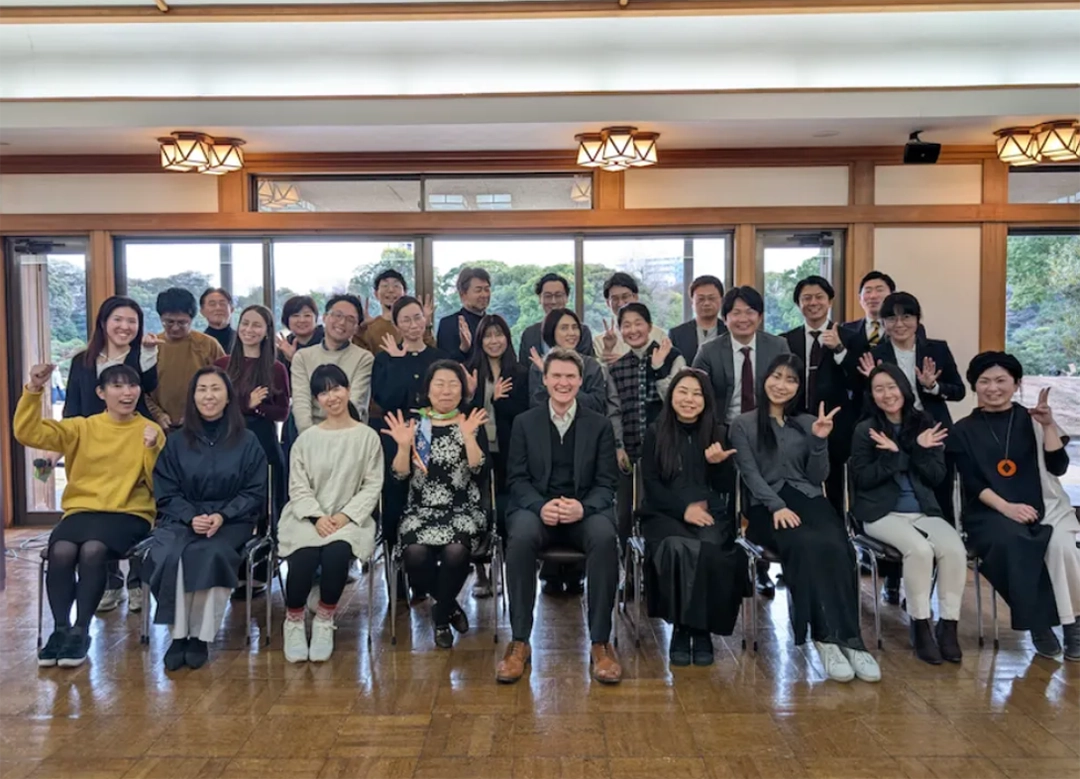
The Japanese attitude toward AI is a study in contrasts. Within the hallowed halls of traditional education, the initial reaction was one of defensive caution. Kazuo Yamamoto of Asknet notes that the education sector first viewed AI as a threat, fueled primarily by the “fear of students using AI to complete assignments”. Teachers in elementary and high schools often struggled to understand how to bridge the gap between their traditional teaching methods and a tool that could instantly generate a passing essay.
Yet, outside the classroom, the economic imperative has forced a rapid evolution. Large Japanese corporations have actively embraced AI as a tool for business efficiency and operations. National debate has moved beyond the fear of job loss - a concern that feels less acute in a country suffering from a chronic labor shortage. As Kazuo put it:
“Japan still has a big challenge around labour shortages... so people find it less threatening... Now what’s more wanted is actually that people are equipped to use AI in their work.”
Guidance from the Japanese Government in 2026 reinforces this. Official views state that the labour shortage is no longer a future problem but a structural reality that hiring alone cannot fix. Consequently, AI is being positioned as the “DX” (Digital Transformation) engine required for the economy.3 In early 2026, the Japanese government introduced the AI Act, aiming to create an agile governance framework that encourages AI adoption while ensuring safety and ethics.4
This shift from “AI as a threat” to “AI as economic opportunity” has fundamentally changed the skills demanded of the workforce. It is no longer enough to be a technician; one must be an “AI-literate human” capable of ethical judgment and critical oversight.
Human Skills: The evolution of essential skills in the Japanese Curriculum
Japan’s approach to building essential skills - often termed ‘human skills’ - has long been a pillar of its educational philosophy, though its implementation has historically been relegated. The Japanese curriculum, while directed by the central government, is not legally binding, allowing schools significant flexibility in how they interpret these guidelines.5
Currently, Japan is in the midst of a critical 10-year curriculum review cycle that will shape education until 2037. This review marks a departure from purely academic attainment toward the measurement of human skills through ‘self-initiative’ and ‘dialogue-based learning’.
The demand from employers
Employers are leading this demand for a more holistic skill set. The Keidanren (Japan Business Federation), emphasizes that as automation handles repetitive tasks, a premium is being placed on human-centric skills like creativity, empathy, and adaptive leadership. Modern HR departments in Japan are moving away from traditional resumes toward “skills intelligence” - mapping what an individual can do rather than where they have been.
Critical thinking also features heavily: In the “Society 5.0” era, students are required to master Higher Order Thinking Skills, including complex problem-solving and social creativity.
The challenge of assessment remains. In the past, teachers measured initiative by counting how many times a student raised their hand or whether they submitted work on time. However, there is an ongoing debate about whether these metrics truly capture the human skills needed for the future. This is where the granular steps of the Skills Builder Framework provide much-needed structure, moving from arbitrary counts to observable progress in skills like Listening, Speaking, and Teamwork.
Befriending the machine: the intersection of AI and essential skills
A unique theme emerging from the Japanese context is the goal of ‘befriending’ AI. Rather than viewing the machine as an ‘other’, the government and educational leaders are discussing how human skill sets can complement technology to create a more resilient society.
The Ministry of Education, Culture, Sports, Science and Technology (MEXT) updated its guidelines for generative AI in 2025, advocating for a human-centered approach.6 The guidelines are clear: AI is a tool to expand human possibilities, but human judgment and responsibility must remain at the end of the process.
“Asknet’s role... is to foster the right ethical thinking around AI use and help young people develop the necessary literacy to build their human skills,” says Yamamoto.
This reflects a growing realization: the more powerful AI becomes, the more important essential skills become. Without Problem Solving skills, an AI’s output cannot be verified. Without Creativity, AI cannot be prompted effectively.
A 2025 survey from Google & Ipsos found that overall respondents from Japan were among the least likely in the world to feel that AI is for them.7 This gap creates a critical need for educators who can guide students not just in how to use the technology, but in when it is appropriate to do so. The dialogue has shifted from “prohibition” to “literacy” and “coexistence”.8

Scaling the future: initiatives for human-centric innovation
To address the challenge of building these skills at scale, several high-profile initiatives are underway across Japan, blending government policy with grassroots social innovation.
ASKNET and Skills Builder Partnership
Asknet, in partnership with Skills Builder, is at the forefront of localizing these global standards. They are currently finalising the translation of the Skills Builder Handbook into Japanese. This is more than a linguistic task; it is a cultural translation that aligns the 16 steps of the Universal Framework with the ‘human skills’ terminology used by the Japanese Ministry of Education. By providing a rigorous, measurable structure, they are helping teachers move beyond hand-counting toward true developmental assessment.
Government pilot schools
MEXT has designated Generative AI Pilot Schools to test how AI can be used to enhance - rather than replace - creativity and motivation. Early results from these pilots suggest that students who experiment with AI to “obtain the intended output” actually enhance their problem-solving and creative thinking.
GIGA School Project & Society 5.0
The national GIGA School Project (Global and Innovation Gateway for All) has already provided one device for every student in Japan. The integration of Higher Order Thinking Skills into digital platforms ensures that students aren’t just consumers of technology, but creators and critics.
Conclusion: the Japanese lesson
Japan’s journey suggests that the ‘AI revolution’ is, at its heart, a human one. By treating AI as a tool for national survival and focusing on the essential skills required to direct it, Japan is providing a blueprint for other aging societies. The lesson is clear: when the workforce shrinks, the value of each individual worker - and their uniquely human skills - only grows.
Investing in these skills is not an afterthought; it is the prerequisite for thriving in a world of technological change. For Japan, the goal is not just to build better AI, but to build better humans to lead it.
References
- Asknet (2026) Interview with Kazuo Yamamoto, Naho Kawashima and colleagues (Asknet Japan): AI Readiness and Essential Skills. [Interview] Interviewed by Tom Ravenscroft, 28 April 2026.
- Cabinet Office of Japan (2025) Outline of the Act on Promotion of Research and Development, and Utilization of AI-related Technology (AI Act). Available at: https://www8.cao.go.jp/cstp/ai/ai_hou_gaiyou_en.pdf
- Council for Science, Technology and Innovation Cabinet Office, Government of Japan (December 18, 2015) Report on The 5th Science and Technology Basic Plan. At https://www8.cao.go.jp/cstp/kihonkeikaku/5basicplan_en.pdf
- Fukuda, N. (2026) Generative AI and Employment in Japan - How to ensure young people develop skills. JRI Research Journal. (Vol.9 No. 11 June 15, 2026) At https://www.jri.co.jp/en/MediaLibrary/file/english/periodical/jrirj/2026/11/fukuda.pdf
- Google & Ipsos (2025) Our Life with AI. Available at: https://www.ipsos.com/sites/default/files/ct/news/documents/2025-10/IpsosGoogle_our-life-with-ai_2025.pdf
- Japanese Ministry of Education, Culture, Sports, Science and Technology (MEXT) (2025) Updated Guidelines on the Use of Generative AI in Primary and Secondary Education. Tokyo: MEXT. Available at: https://www.mext.go.jp/content/20250422-mxt_shuukyo01-000030823_001.pdf [Accessed 22 May 2026]
- Ministry of Education, Culture, Sports, Science and Technology (MEXT) (2025) Guideline for the Use of Generative AI in Primary and Secondary Education (Ver2.0). Tokyo: MEXT. Available at: https://www.mext.go.jp/content/20250422-mxt_shuukyo01-000030823_001.pdf [Accessed 22 May 2026]
- Ministry of Internal Affairs and Communications Ministry of Economy, Trade and Industry (31 March 2026) AI Guidelines for Business Ver1.2. At https://www.meti.go.jp/shingikai/mono_info_service/ai_shakai_jisso/pdf/20260331_12.pdf
- Recruit Works Institute (2023) Future Forecast 2040: The 11 Million Worker Shortage. Tokyo: Recruit Holdings. Available at https://recruit-holdings.com/en/blog/post_20230926_0001/ [Accessed 22 May 2026]